
Histórico da Página
| Índice |
|---|
| Aviso | ||
|---|---|---|
| ||
Fique atento! Reforma Tributária não é apenas sistêmica, mas estruturalAttention! The Tax Reform is not only systemic but also structural. |
| Nota | ||
|---|---|---|
| ||
Os exemplos apresentados nesta documentação têm caráter meramente ilustrativo e servem como sugestão de forma de contabilizar o cenário de estorno de crédito. Caso o cenário real da empresa possua particularidades — como diferentes métodos de depreciação, políticas internas de estorno ou campos personalizados —, é indispensável ajustar a fórmula conforme a realidade operacional e as regras fiscais aplicáveis. |
...
| |
The examples presented in this documentation are for illustrative purposes only and serve as a suggestion for how to account for a credit reversal scenario. If the company’s real scenario contains particularities—such as different depreciation methods, internal reversal policies, or customized fields —, it is essential to adjust the formula according to operational reality and the applicable tax regulations. |
01.Objetives
To calculate the proportional amount of IBS/CBS credit reversal in cases of write-off, disposal, or loss of fixed assets, according to the criteria defined by Complementary Law Calcular o valor proporcional de estorno de crédito de IBS/CBS em casos de baixa, inutilização ou perda de bens do ativo imobilizado, conforme os critérios definidos pela LC 214/2025, art. 47, §§6º a to 8º.
O cálculo considera:
The calculation takes into account:
- The useful life of the asset (depreciation rate).
- The usage period up to the posting-off date.
- The percentage of the asset posting off (in the case of partial write-off
A vida útil do bem (taxa de depreciação);
O tempo de uso até a data da baixa;
- E o percentual baixado do bem (quando a baixa é parcial).
02.
...
IBS/CBS Credit Reversal Calculation
2.1
...
Formula used en the Standard Entries (LP 810)
CTBVLTRIB(SN1->N1_IDTRIB,"IBSEST",,.T.)*SN4->N4_QUANTD*(1-((SN4->N4_DATA-SN1->N1_AQUISIC)/((100/SN3->N3_TXDEPR1)*365)))
2.2
...
Component Description
Field / Function | Description |
...
| Campo / Função | Descrição|
|---|---|
CTBVLTRIB(SN1->N1_IDTRIB,"IBSEST",,.T.) | Retorna o valor total do crédito tributário Returns the total value of the tax credit (IBS/CBS) registrado na aquisição do bemrecorded at the time of asset acquisition. |
N4_QUANTD | Representa o percentual fracionado da quantidade baixada Represents the fractional percentage of the quantity written off (ex: 0,4 = 40%). |
N4_DATA | Data em que a baixa do ativo foi realizada Date when the asset write-off was performed. |
SN1->N1_AQUISIC | Data da aquisição do bem no sistema Date of the asset acquisition in the system. |
SN3->N3_TXDEPR1 | Taxa de depreciação anual cadastrada para o bem (em Annual depreciation rate registered for the asset (in %). |
365Converte a taxa anual em dias para o cálculo proporcional | Converts the annual rate into days for proportional calculation. |
2.3
...
Calculation Logic
The credit reversal consists of two proportionsO estorno de crédito é composto de duas proporções:
1 - Proporção da quantidade baixada:
Representa a fração do bem que está sendo baixada no momento.Proportion of the quantity written off:
Represents the fraction of the asset being written off at that moment.
ExampleExemplo: N4_QUANTD = 0,4 → o bem está sendo baixado em The asset is being written off at 40%.
2 - Proporção do crédito remanescente:
Indica o quanto ainda não foi “consumido” pela depreciação (vida útil).Proportion of the remaining credit:
Indicates how much of the credit has not yet been “consumed” through depreciation (useful life).
It is calculated asÉ calculada como:
1 - (tempo de uso / vida útil totalusage time / total useful life)
Assim, quanto mais antigo o bem, menor o crédito remanescente a ser estornadoThus, the older the asset, the smaller the remaining credit to be reversed.
2.4
...
Calculation Steps
1 - Determinar o valor total de crédito do bemDetermine the total credit amount of the asset:
CTBVLTRIB(SN1→N1_IDTRIB,"IBSEST",,.T.)
2 -Aplicar o percentual da baixa: Apply the write-off percentage:
Multiply the total credit by the fractional value in Multiplica o crédito total pelo valor fracionado em N4_QUANTD
(ex.: 40% = 0,4 → 40% do créditoof the credit).
3 -Aplicar o fator de tempo de uso (depreciação):
Calcula o quanto do crédito ainda “resta”, considerando a vida útil.

Apply the usage time factor (depreciation):
Calculate how much of the credit still “remains,” considering the asset’s useful life.
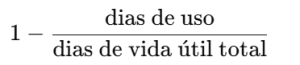
4 - Final result4 - Resultado final:

2.4
...
Practical example
Data | Valor | Value |
|---|---|---|
Total credit amount Valor total do créditoIBS | R$ 1.000,00 | |
| Data de aquisição The acquisition date. | 01/01/2023 | |
| Data da baixa Write-off Date | 01/01/2025 | |
| Taxa de depreciação Rate of depreciation | 25% a.a. | |
| Percentual baixado Posting-off Percentage (N4_QUANTD) | 0,4 (40%) |
CálculoCalculation:
1 - Vida útil totalTotal useful life:
100 ÷ 25 = 4 anos = 1460 dias years = 1,460 days
2 - Tempo de usoTime in use:
01/01/2025 − 01/01/2023 =730 diasdays
3 - Proporção remanescenteRemaining proportion:
1 − (730 ÷ 1460) = 0,5
4 - Aplicando a fórmulaApplying the formula:
1.,000 × 0,.4 × 0,.5 = 200
Valor de estorno Reversal value = R$ 200,.00
Interpretação prática
Se o bem ainda estava no início da vida útil, o estorno será maior, pois o crédito não foi “consumido” pela depreciação.
Se o bem já estava no fim da vida útil, o estorno será menor, pois o crédito já foi totalmente aproveitado.
Quando o bem é baixado parcialmente, o sistema considera apenas a fração (
N4_QUANTD) correspondente à baixa.
03. Fórmula explicada em partes (na ordem de cálculo)
A ideia é calcular da direita para a esquerda, respeitando a ordem de precedência matemática:
...
Practical interpretation
- If the asset was still at the beginning of its useful life, the reversal amount will be higher, since the credit has not yet been “consumed” through depreciation.
- If the asset was nearing the end of its useful life, the reversal amount will be lower, since most of the credit has already been used.
- When an asset is partially posting off, the system considers only the fraction (N4_QUANTD) related to the write-off.
03. Formula explained step by step (calculation order)
The idea is to calculate from right to left, respecting mathematical precedence:
1️⃣ Inner parentheses first
2️⃣ Multiplication and divisions
3️⃣ Subtractions and additions
Step 1 – Calculate the asset’s total useful life (in years, then in days)
Formula excerpt
...
Passo 1 – Calcular a vida útil total do bem (em anos e depois em dias)
Trecho da fórmula:
(100 / SN3->N3_TXDEPR1) * 365
SubstituindoSubstituting:
(100 / 25) * 365
→ 4 × 365 = 1460 dias de vida útil total
Passo 2 – Calcular o tempo de uso do bem (em dias)
1,460 days of total useful life
...
Step 2 – Calculate the asset’s use time (in days)
Formula excerptTrecho:
N4_DATA - SN1->N1_AQUISIC
→ 2025-01-01 - 2023-01-01 = 730 diasdays
Passo 3 – Calcular o percentual da vida útil já usada
...
Step 3 – Calculate the percentage of useful life already used
Formula excerptTrecho:
((N4_DATA - SN1->N1_AQUISIC) / ((100 / SN3->N3_TXDEPR1) * 365))
SubstituindoSubstituting:
730 / 1460 = 0,5
→ O bem já usou 50% da vida útil.
Passo 4 – Calcular o percentual remanescente do crédito
The asset has already used 50% of its useful life.
...
Step 4 – Calculate the remaining credit percentage
Formula excerptTrecho:
1 - (resultado anteriorprevious result)
SubstituindoSubstituting:
1 - 0,5 = 0,5
→ Ainda resta 50% do crédito (proporção remanescente 50% of the credit remains (remaining proportion).
...
Passo Step 5 – Aplicar o percentual de baixa (quantidade baixada)Apply the write-off percentage (quantity written off)
Formula excerptTrecho:
N4_QUANTD * (resultado anteriorprevious result)
SubstituindoSubstituting:
0,4 * 0,5 = 0,2
→ O total que será estornado equivale a 20% do crédito total.
Passo 6 – Aplicar ao valor do crédito IBS
The total to be reversed equals 20% of the total credit.
...
Step 6 – Apply to the IBS credit value
Formula excerptTrecho:
CTBVLTRIB(...) * (resultado anteriorprevious result)
SubstituindoSubstituting:
1.000 * 0,2 = 200
Valor final do estorno Final reversal value = R$ 200,00
...
Resumo da sequência com ordem de cálculoSummary of the sequence with calculation order
| Ordem | Operação | Resultado |
|---|---|---|
| 1 | (100 ÷ 25) × 365 | 1460 |
| 2 | 2025-01-01 − 2023-01-01 | 730 |
| 3 | 730 ÷ 1460 | 0,.5 |
| 4 | 1 − 0,5 | 0,.5 |
| 5 | 0,4 × 0,5 | 0,.2 |
| 6 | 1.000 × 0,2 | 200,00 |
Interpretação práticaPractical interpretation
🔹 O bem vale The asset has R$ 1.,000 em créditoin credit.
🔹 Você está baixando 40% dele.
🔹 O bem já usou metade da sua vida útil (2 de 4 anosYou are writing off 40% of it.
🔹 The asset has used half of its useful life (2 of 4 years).
🔹 LogoTherefore, ainda resta 50% do crédito aproveitável50% of the credit is still available.
🔹 40% × 50% = 20% do of the total → R$ 200 de estornoreversal.
04.
...
Related Documents
- How to Account for Como Contabilizar IBS, CBS e , and IS?
- Accounting Based on Tax Classification
- Accounting Based on Tax ClassificationContabilização com Base na Sigla do Tributo
Visão Geral
Import HTML Content
Conteúdo das Ferramentas
Tarefas