This documentation refers to the new process editor of the platform. If you are using the current process editor, access Configure activity. |

Speaking of rules for attachments in requests... 
The rules for attachments are conditions or prerequisites that can be defined in the Start and Activity components, which represent stages of a process. They can require, prohibit, or allow attachments with specific characteristics, such as file names, extensions, number of files, among others – regardless of the attachments that already exist in the request, in previous stages, for example – ensuring that the stage is complete and meets the criteria required for the request to proceed.
The rules for attachments can be:
- general: these are simpler rules aimed at requiring quantities of attachments;
- specific: these are rules that, combined with the general ones, allow for requiring specific characteristics of the attachments, such as name or extension;
- advanced: these are specific rules with conditions defined from special characters, each with its own meaning.
The rules for attachments are not mandatory in any component. They can or cannot be defined according to the specific needs of each stage, process, or business. If no rule is defined, it is allowed to add any type and any quantity of attachments, meaning that no validation is performed. |
Click here to learn how to configure rules for attachments in a stage of the process. |

Objective of the rules
The rules aim to expedite the resolution of requests, as they prevent the request from being forwarded without the necessary content for analysis in the next step being complete or correct, for example, which would require the request to be returned for adjustments.
In this way, the rules help to avoid rework and delays in the resolution of requests, as well as aim to facilitate the analysis of each step and the understanding of what is being requested.
Order of rule verification
At the moment of moving the request to the next step, the rules for attachments of the current step are verified, and if any of them are not met, a message is displayed informing which rules have been met and which have not.
It is necessary for all rules to be met and all attachments to be valid for the step to be completed and the request to be sent to the next one. When an attachment is considered valid for a rule, it is not verified against the other rules. Therefore, there is an order in which the rules are verified, and it is important to consider this when creating the rules.
The order of rule verification for the attachments of the step is:
- 1º → The rules for quantity, name, and extension are verified. Valid attachments for each rule are analyzed. If any of the rules are not met, the validation message is displayed, and sending to the next step is not allowed.
2º → It is verified if there is a rule with any and if there is an attachment that has not met any previous rules. If so, the attachment will be considered valid, as it meets the rule with any (which is the last to be verified), and sending to the next step is allowed. Otherwise – there is no rule with any, but there is an attachment that has not met any previous rules – the validation message is displayed, and sending to the next step is not allowed, even if the other attachments have met the previous rules.

→ A step has 3 rules for attachments, one of which is with any one.
→ 4 attachments were added. Two of them met the first rule, one met the second rule, and the fourth did not meet either of the two rules (which are checked before the rule with any one).
→ Since the third rule has the any one, this fourth attachment meets it. In this case, all rules were met and all attachments are valid. Therefore, submission to the next step is allowed.
|

→ A step has 2 rules for attachments and none of them use any one.
→ 3 attachments were added. One met the first rule, another met the second rule, and the third did not meet either of the two rules.
→ Since there is no rule with any one, this third attachment did not meet any rule. In this case, it will not be considered valid. Therefore, submission to the next step is not allowed.
|
General rule
General rules are the simplest and serve to define the required number of attachments or whether the attachment can be of any type and in any quantity at the step.
Check below an example for each condition available for creating general rules for attachments.
→ The attachment must be equal to 2. It is mandatory to add two attachments at this step, and adding more is not allowed. |
→ The attachment must be greater than 0. It is mandatory to add at least one attachment at this step, and adding more than one is allowed. |
→ The attachment must be greater than or equal to 1. It is mandatory to add at least one attachment at this step, and adding more than one is allowed. |
→ The attachment must be less than 3. It is allowed to add up to two attachments at this step or leave the step without attachments. |
→ The attachment must be less than or equal to 4. It is allowed to add up to four attachments at this step or leave the step without attachments. |
→ The attachment must be any one. It is allowed to add any type and any quantity of attachments at this step, including leaving the step without attachments. |

In a process of Request for hour exemption due to medical issues for the Payroll area, the requester must necessarily submit the medical certificate that justifies the exemption. The certificate is accepted in any format, which can be an image, a photo, a PDF document, a ZIP file, in short, no requirements are made regarding the type of file. However, only one certificate is allowed to be submitted per request, meaning that if the requester has more than one certificate, they must open a request for each one.
Thus, the rule can be defined as follows: → The attachment must equal 1. It is mandatory to add one attachment of any type. And it is not allowed to add more than one. 
|

In a process of Simple budget approval, the person responsible for the approval prefers that the details be provided directly in the request form, so that when opening the request for analysis, the amount to be approved is already evident, without the need to open a document to see the information.
→ In this case, it is not necessary to add any rules, just activate the option Prohibit attachments, which means that no attachments are allowed at this stage. The budget details must be added in the request form. 
|
Specific rule
Specific rules need to be combined with general rules to allow or require specific characteristics of the attachments, such as file name and extension.
It is possible to define, for example, that only attachments with a certain type of extension are allowed or to require that the attached file follows a predetermined naming pattern.
Check below some examples of specific rules for attachments.
→ The attachment must be equal to 1 with the file name containing the term note at the beginning. It is mandatory to add an attachment that has the term note at the beginning of its name. |
→ The attachment must be less than or equal to 2 with the extension equal to .zip. It is allowed to add up to two attachments with the .zip extension or leave the step without attachments. |
→ The attachment must be equal to 1 with the name and extension containing the term boleto at the beginning and the term .pdf at the end. It is mandatory to add an attachment that has the term boleto at the beginning of its name and that is a PDF document. |
In a ticket opening process for the IT department, the requester needs to send at least one image of the inconsistency that is occurring or of the resource for which they are requesting assistance. Only images of the PNG type are accepted. If possible, it is also interesting to send the log, but it must be in TXT format and is not mandatory.
Thus, the rules can be defined as follows: → The attachment must be greater than or equal to 1 with the extension equal to .png. It is mandatory to add at least one attachment that is an image with the .png extension. However, if the requester wishes, they can add more attachments. → The attachment must be greater than or equal to 0 with the extension equal to .txt. If the requester can obtain the log, they can attach it to the request to facilitate analysis. However, it is not mandatory to attach it. → The attachment must be equal to 0 with the extension equal to .exe. For security reasons, it is not allowed to add any attachment that has the .exe extension. 
|
In a payment request process for the Finance area, the requester must submit three documents: the electronic invoice, the payment slip, and a detailed list of the products or services acquired. The documents must be in PDF format and identified by the respective names "boleto", "fatura", and the invoice must be identified with the code "NF" at the beginning of the name.
Thus, the rules can be defined as follows: → The attachment must be equal to 1 with the name and extension containing the term boleto in the name and the term pdf in the extension. It is mandatory to add an attachment that has the name boleto and is a document with the .pdf extension. → The attachment must be equal to 1 with the name and extension containing the term fatura in the name and the term pdf in the extension. It is mandatory to add an attachment that has the name fatura and is a document with the .pdf extension. → The attachment must be equal to 1 with the name and extension containing the term NF at the beginning of the name and the term pdf at the end of the extension. It is mandatory to add an attachment with the characters NF at the beginning of its name and with the .pdf extension to identify it as the invoice. Attachments such as NF_10355.pdf, NF89665.doc.pdf, NF-58361.pdf would be accepted. 
|
Advanced rule
The advanced rules are defined from an expression that can use a combination of the following characters:
* (asterisk): allows for any characters to be present or absent before or after it.

boleto* → means containing the term boleto at the beginning of the name, which may or may not have any other characters after the term, including in the extension – allowed by *. Attachments such as boleto.pdf or boleto-janeiro.png would be accepted.
|
| (pipe): means "or" and allows defining multiple patterns.
.pdf|.doc|.docx|.txt → means it can be .pdf, .doc, .docx, or .txt – extensions allowed by | – which may have any name before the extension – allowed by *. Attachments such as processo.pdf or anotações.txt would be accepted.
|
! (exclamation): means "different from" or "prohibited" and allows blocking a pattern.
!*.zip → means different from .zip – the extension is prohibited by ! – it can have any name before the extension – allowed by *. Attachments like boleto.pdf or processo.png would be accepted.
|
Check out some more examples of advanced rules for attachments.
→ The attachment must be equal to 1 with advanced condition fatura.pdf|nota.pdf. It is mandatory to add an attachment named fatura or nota with the .pdf extension. Adding more than one is not allowed. |
→ The attachment must be any with advanced condition !server.*. It is allowed to add any type of attachment with a name different from server and with any extension or leave the step without attachments. The name server is prohibited. |
→ The attachment must be greater than or equal to 3 with advanced condition boleto.pdf. It is mandatory to add at least 3 attachments, and more can be added, that contain the term boleto in the name and with the .pdf extension. |
In a Travel Reimbursement Request process for the Finance area, the requester can submit proof of payment for the stay, transportation, and ticket if the trip was for an event. The proofs need to be in PDF and identified by name. Thus, the rules can be defined as follows: → The attachment must be greater than or equal to 1 with advanced condition estadia.pdf|transporte.pdf|ingresso.pdf. It is mandatory to add at least one attachment, and more can be attached, that contains the term estadia, transporte, or ingresso in the name and with the .pdf extension. 
|
In a Request for Office Supplies process for the Purchasing area, the requester needs to submit a photo of the requested material to serve as a reference and facilitate the purchase. This photo can be of various types. Thus, the rules can be defined as follows: → The attachment must be greater than or equal to 1 with advanced condition .png|.jpg|.jpeg|.bmp. It is mandatory to add at least 1 attachment with any name that is an image with one of the allowed extensions: .png, .jpg, .jpeg, or .bmp. 
|
Usage examples
We have gathered several scenarios here in which rules for attachments can be applied. The examples include the rule, a help message to comply with the rule, and the results according to the scenario.
Examples of general, specific, and advanced rules are demonstrated. Click on each scenario to see its details.
<script>
    (function() {
        function toggleAreas(isExpand, $parent) {
            var $items = $parent.find('.panel');

            $.each($items, function(idx, el) {
                var $arrow = $(el).find('span.cloakToggle').find('span');
                var $content = $(el).find('span.cloak');
                if (isExpand) {
                    $arrow.removeClass('cloakDefaultOpen').addClass('cloakDefaultClose');
                    $content.show();
                } else {
                    $arrow.addClass('cloakDefaultOpen').removeClass('cloakDefaultClose');
                    $content.hide();
                }
            });
        }

        $(document).on('click', '#toggleAll-1', function(ev) {
            ev.preventDefault();
            var isExpand = $(this).data('expand');
            var $parent = $(this).nextAll('.sectionColumnWrapper').first();
            toggleAreas(isExpand, $parent);
            $(this).data('expand', !isExpand);
        });
    })();
</script>
<a id="toggleAll-1" href="#" data-expand="true">Open/close all scenarios</a> |
 Require at least one attachment in the step. Require at least one attachment in the step.

→ The attachment must be greater than 0. 
→ It is mandatory to add at least one attachment of any type. | Results | | No attachment added. | | | | Um anexo com a extensão .pdf adicionado. | | | | Um anexo com a extensão .zip adicionado. | | | | Um anexo com a extensão .zip e um com a extensão .pdf adicionados. | | | | Um anexo com a extensão .jpg adicionado. | | | | Um anexo com a extensão .pdf, um com a extensão .zip e um com a extensão .jpg adicionados. | | |
|
|
 Proibir anexo na etapa. Proibir anexo na etapa.
Para proibir anexos em uma etapa, não é necessário criar nenhuma regra, basta ativar a opção Proibir anexos, que determina que não é permitido adicionar nenhum anexo na etapa. 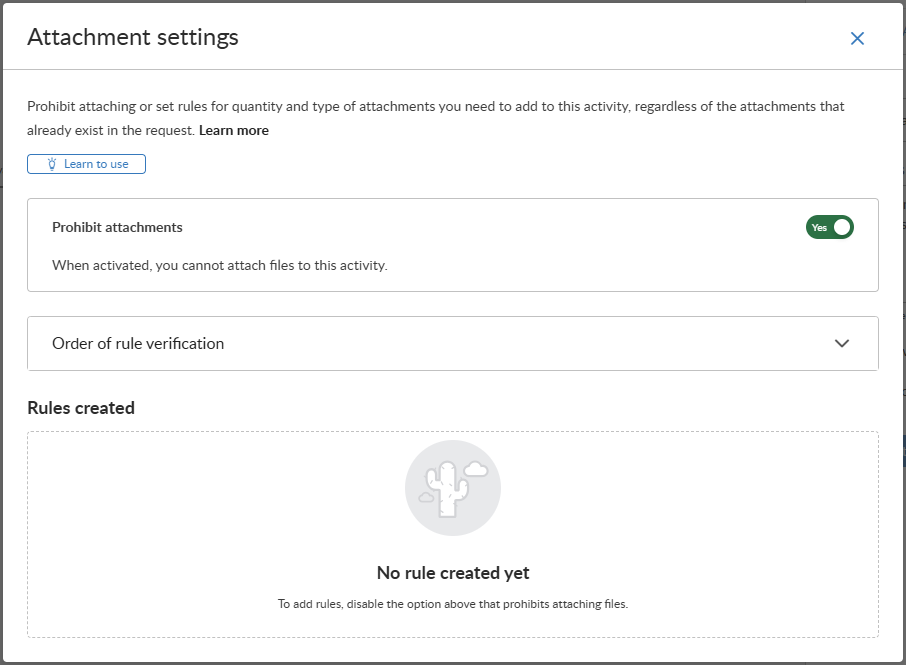
|
|
 Exigir um anexo com a extensão .zip. Exigir um anexo com a extensão .zip.
→ O anexo deve ser igual a 1 com a extensão igual a .zip.
→ É obrigatório adicionar um anexo com a extensão .zip. | Results | No attachment added. | | | Um anexo com a extensão .pdf adicionado. | | | Um anexo com a extensão .zip adicionado. | | | | Um anexo com a extensão .zip e um com a extensão .pdf adicionados. | | | | Um anexo com a extensão .jpg adicionado. | | | | Um anexo com a extensão .pdf, um com a extensão .zip e um com a extensão .jpg adicionados. | | |
|
|
 Exigir um anexo com a extensão .zip E um anexo com a extensão .pdf. Exigir um anexo com a extensão .zip E um anexo com a extensão .pdf.

→ O anexo deve ser igual a 1 com a extensão igual a .zip.
→ O anexo deve ser igual a 1 com a extensão igual a .pdf. 
→ É obrigatório adicionar um anexo com a extensão .zip.
→ É obrigatório adicionar um anexo com a extensão .pdf. | Results | No attachment added. | | | Um anexo com a extensão .pdf adicionado. | | | Um anexo com a extensão .zip adicionado. | | | | Um anexo com a extensão .zip e um com a extensão .pdf adicionados. | | | | Um anexo com a extensão .jpg adicionado. | | | | Um anexo com a extensão .pdf, um com a extensão .zip e um com a extensão .jpg adicionados. | | |
|
|
 Exigir um anexo com a extensão .zip OU .pdf. Exigir um anexo com a extensão .zip OU .pdf.
→ O anexo deve ser igual a 1 com condição avançada .zip|.pdf.
→ É obrigatório adicionar um anexo com a extensão .zip ou com a extensão .pdf. | Results | No attachment added. | | | Um anexo com a extensão .pdf adicionado. | | | Um anexo com a extensão .zip adicionado. | | | | Um anexo com a extensão .zip e um com a extensão .pdf adicionados. | | | | Um anexo com a extensão .jpg adicionado. | | | | Um anexo com a extensão .pdf, um com a extensão .zip e um com a extensão .jpg adicionados. | | |
|
|
 Exigir um anexo com a extensão .zip e deixar livre para anexar ou não outros tipos de anexo. Exigir um anexo com a extensão .zip e deixar livre para anexar ou não outros tipos de anexo.
→ O anexo deve ser igual a 1 com a extensão igual a .zip.
→ O anexo deve ser qualquer um. 
→ É obrigatório adicionar um anexo com a extensão .zip. Results | No attachment added. | | | Um anexo com a extensão .pdf adicionado. | | | Um anexo com a extensão .zip adicionado. | | | | Um anexo com a extensão .zip e um com a extensão .pdf adicionados. | | | | Um anexo com a extensão .jpg adicionado. | | | | Um anexo com a extensão .pdf, um com a extensão .zip e um com a extensão .jpg adicionados. | | |
|
|
 Proibir anexo com a extensão .zip e deixar livre para anexar ou não outros tipos de anexo. Proibir anexo com a extensão .zip e deixar livre para anexar ou não outros tipos de anexo.
→ O anexo deve ser igual a 0 com a extensão igual a .zip.
→ O anexo deve ser qualquer um.
→ Não é permitido adicionar um anexo com a extensão .zip. Results | No attachment added. | | | Um anexo com a extensão .pdf adicionado. | | | Um anexo com a extensão .zip adicionado. | | | | Um anexo com a extensão .zip e um com a extensão .pdf adicionados. | | | | Um anexo com a extensão .jpg adicionado. | | | | Um anexo com a extensão .pdf, um com a extensão .zip e um com a extensão .jpg adicionados. | | |
|
|
 Exigir um anexo com a extensão .zip e exigir pelo menos outro tipo de anexo. Exigir um anexo com a extensão .zip e exigir pelo menos outro tipo de anexo.
→ O anexo deve ser igual a 1 com a extensão igual a .zip.
→ O anexo deve ser maior ou igual a 1 com a extensão diferente de .zip.
→ É obrigatório adicionar um anexo com a extensão .zip.
→ É obrigatório adicionar pelo menos um anexo com a extensão diferente de .zip. Results | No attachment added. | | | Um anexo com a extensão .pdf adicionado. | | | Um anexo com a extensão .zip adicionado. | | | | Um anexo com a extensão .zip e um com a extensão .pdf adicionados. | | | | Um anexo com a extensão .jpg adicionado. | | Rules not met. | | Um anexo com a extensão .pdf, um com a extensão .zip e um com a extensão .jpg adicionados. | | |
|
|
 Exigir um ou mais anexos do tipo imagem. Exigir um ou mais anexos do tipo imagem.
→ O anexo deve ser maior ou igual a 1 com condição avançada .png|.jpg|.gif.
→ É obrigatório adicionar pelo menos um anexo com a extensão .png, .jpg ou .gif. Results | No attachment added. | | | Um anexo com a extensão .pdf adicionado. | | | Um anexo com a extensão .zip adicionado. | | | | Um anexo com a extensão .zip e um com a extensão .pdf adicionados. | | | | Um anexo com a extensão .jpg adicionado. | | Rule met. | | Um anexo com a extensão .pdf, um com a extensão .zip e um com a extensão .jpg adicionados. | | |
|
|
 Permitir somente anexo do tipo imagem, mas sem torná-lo obrigatório. Permitir somente anexo do tipo imagem, mas sem torná-lo obrigatório.
→ O anexo deve ser maior ou igual a 0 com condição avançada .png|.jp*g|.gif.
→ São permitidos apenas anexos com as extensões .png, .jpg, .jpeg ou .gif. Results | No attachment added. | | | Um anexo com a extensão .pdf adicionado. | | | Um anexo com a extensão .zip adicionado. | | | | Um anexo com a extensão .zip e um com a extensão .pdf adicionados. | | | | Um anexo com a extensão .jpg adicionado. | | Rule met. | | Um anexo com a extensão .pdf, um com a extensão .zip e um com a extensão .jpg adicionados. | | |
|
|
 Exigir um anexo com nome e extensão específicos. Exigir um anexo com nome e extensão específicos.
→ O anexo deve ser igual a 1 com o nome e extensão igual a no nome o termo server e na extensão o termo .log.
→ Somente um anexo com o nome server.log é permitido. Results | No attachment added. | | | Um anexo server.log adicionado. | | | Um anexo abcserver.log adicionado. | | | | Um anexo server-2018.log adicionado. | | | | Um anexo server.txt adicionado. | | Rule not met. | | Um anexo server.log.zip adicionado. | | | | Um anexo server.zip adicionado. | | |
|
|
 Exigir um anexo com termo específico no início do nome e extensão específica. Exigir um anexo com termo específico no início do nome e extensão específica.
→ O anexo deve ser igual a 1 com condição avançada server*.log.
→ É obrigatório adicionar um anexo com server no início do nome e com a extensão .log. Results | No attachment added. | | | Um anexo server.log adicionado. | | | Um anexo abcserver.log adicionado. | | | | Um anexo server-2018.log adicionado. | | | | Um anexo server.txt adicionado. | | Rule not met. | | Um anexo server.log.zip adicionado. | | | | Um anexo server.zip adicionado. | | |
|
|
 Exigir um anexo com termo específico no início do nome e da extensão. Exigir um anexo com termo específico no início do nome e da extensão.
→ O anexo deve ser igual a 1 com o nome e extensão contendo no nome o termo server no início e na extensão o termo .log no início.
→ É obrigatório adicionar um anexo com server no início do nome e com .log no início da extensão. Results | No attachment added. | | | Um anexo server.log adicionado. | | | Um anexo abcserver.log adicionado. | | | | Um anexo server-2018.log adicionado. | | | | Um anexo server.txt adicionado. | | Rule not met. | | Um anexo server.log.zip adicionado. | | | | Um anexo server.zip adicionado. | | |
|
|
 Exigir um anexo contendo um termo específico no nome e no início da extensão. Exigir um anexo contendo um termo específico no nome e no início da extensão.
→ O anexo deve ser igual a 1 com condição avançada *server*.log*.
→ É obrigatório adicionar um anexo que contenha server no nome e .log no início da extensão. Results | No attachment added. | | | Um anexo server.log adicionado. | | | Um anexo abcserver.log adicionado. | | | | Um anexo server-2018.log adicionado. | | | | Um anexo server.txt adicionado. | | Rule not met. | | Um anexo server.log.zip adicionado. | | | | Um anexo server.zip adicionado. | | |
|
|
 Proibir anexo com termo específico no nome e deixar livre para anexar ou não outros tipos de anexo. Proibir anexo com termo específico no nome e deixar livre para anexar ou não outros tipos de anexo.
→ O anexo deve ser qualquer um com condição avançada !*server*. OU → O anexo deve ser igual a 0 com condição avançada *server*.
→ O anexo deve ser qualquer um.
→ Não é permitido adicionar um anexo que contenha server no nome. Results | No attachment added. | | | Um anexo server.log adicionado. | | | Um anexo abcserver.log adicionado. | | | | Um anexo server-2018.log adicionado. | | | | Um anexo server.txt adicionado. | | Rules not met. | | Um anexo server.log.zip adicionado. | | | | Um anexo server.zip adicionado. | | | | Um anexo boleto.pdf adicionado. | | |
|
|
 Proibir anexo com termo específico no nome e exigir um anexo com outro nome. Proibir anexo com termo específico no nome e exigir um anexo com outro nome.
→ O anexo deve ser igual a 1 com condição avançada !*server*.
→ É obrigatório adicionar um anexo que não contenha server no nome. Results | No attachment added. | | | Um anexo server.log adicionado. | | | Um anexo abcserver.log adicionado. | | | | Um anexo server-2018.log adicionado. | | | | Um anexo server.txt adicionado. | | Rule not met. | | Um anexo server.log.zip adicionado. | | | | Um anexo server.zip adicionado. | | | | Um anexo boleto.pdf adicionado. | | |
|
|
 Exigir anexo com extensão específica somente se tiver um nome específico ou qualquer anexo de outra extensão. Exigir anexo com extensão específica somente se tiver um nome específico ou qualquer anexo de outra extensão.
→ O anexo deve ser igual a 1 com condição avançada server.log|!*.log.
→ É obrigatório adicionar um anexo com o nome server e com a extensão .log ou qualquer anexo com a extensão diferente de .log. Results | No attachment added. | | | Um anexo server.log adicionado. | | | Um anexo abcserver.log adicionado. | | | | Um anexo server-2018.log adicionado. | | | | Um anexo server.txt adicionado. | | Rule met. | | Um anexo server.log.zip adicionado. | | | | Um anexo server.zip adicionado. | | | | Um anexo boleto.pdf adicionado. | | |
|
|
 Exigir anexo com termo específico no início do nome e extensão específica ou qualquer anexo de outra extensão. Exigir anexo com termo específico no início do nome e extensão específica ou qualquer anexo de outra extensão.
→ O anexo deve ser igual a 1 com condição avançada server*.log|!*.log.
→ É obrigatório adicionar um anexo com server no início do nome e com a extensão .log ou qualquer anexo com a extensão diferente de .log. Results | No attachment added. | | | Um anexo server.log adicionado. | | | Um anexo abcserver.log adicionado. | | | | Um anexo server-2018.log adicionado. | | | | Um anexo server.txt adicionado. | | Rule met. | | Um anexo server.log.zip adicionado. | | | | Um anexo server.zip adicionado. | | | | Um anexo boleto.pdf adicionado. | | |
|
|
 Proibir anexo com termo específico no nome e permitir qualquer anexo com extensão específica. Proibir anexo com termo específico no nome e permitir qualquer anexo com extensão específica.
→ O anexo deve ser igual a 0 com o nome do arquivo contendo irpf no meio.
→ O anexo deve ser qualquer um com a extensão igual a .zip.
→ Não é permitido adicionar um anexo que contenha irpf no nome.
→ É permitido adicionar qualquer anexo com a extensão .zip.
Results | No attachment added. | | | Um anexo declaracao-irpf.pdf adicionado. | | | Um anexo abcserver.log adicionado. | | | | Um anexo server-2018.log adicionado. | | | | Um anexo server.txt adicionado. | | Rules not met. | | Um anexo server.log.zip adicionado. | | | | Um anexo server.zip adicionado. | | | | Um anexo irpf.zip adicionado. | | |
|
|
|
Dúvidas frequentes
Confira aqui algumas dúvidas frequentes sobre anexos em solicitações ou em etapas das solicitações. Clique na dúvida para ver seus detalhes.
<script>
    (function() {
        function toggleAreas(isExpand, $parent) {
            var $items = $parent.find('.panel');

            $.each($items, function(idx, el) {
                var $arrow = $(el).find('span.cloakToggle').find('span');
                var $content = $(el).find('span.cloak');
                if (isExpand) {
                    $arrow.removeClass('cloakDefaultOpen').addClass('cloakDefaultClose');
                    $content.show();
                } else {
                    $arrow.addClass('cloakDefaultOpen').removeClass('cloakDefaultClose');
                    $content.hide();
                }
            });
        }

        $(document).on('click', '#toggleAll-2', function(ev) {
            ev.preventDefault();
            var isExpand = $(this).data('expand');
            var $parent = $(this).nextAll('.sectionColumnWrapper').first();
            toggleAreas(isExpand, $parent);
            $(this).data('expand', !isExpand);
        });
    })();
</script>
<a id="toggleAll-2" href="#" data-expand="true">Abrir/fechar todas as dúvidas</a> |
 O que acontece se o anexo não atender à regra? O que acontece se o anexo não atender à regra?
A etapa na qual a solicitação se encontra não pode ser concluída e, consequentemente, a solicitação não pode ser enviada para a próxima etapa. Todas as regras existentes na etapa precisam ser atendidas e todos os anexos adicionados precisam ser validados por, pelo menos, uma regra para que ela possa ser concluída e a solicitação enviada para a próxima. |
|
 Quais tipos de arquivos são permitidos como anexo? Quais tipos de arquivos são permitidos como anexo?
Existe uma vasta gama de extensões de arquivos que são permitidos como anexos. As principais extensões que são listadas para serem selecionadas na criação de regras para os anexos são detalhadas a seguir. Porém, é possível selecionar outras mais específicas também. Além disso, se a extensão desejada não for sugerida para seleção, é possível digitá-la e ela será considerada normalmente na regra. | Principais extensões |
|---|
| Documentos | .doc / .docx | Microsoft Word Document | | .pdf | Portable Document Format | | .txt | Plain Text File | | .rtf | Rich Text Format | | .odt | OpenDocument Text Document | | Planilhas | .xls / .xlsx | Microsoft Excel Spreadsheet | | .csv | Comma-Separated Values | | .ods | OpenDocument Spreadsheet | | Apresentações | .ppt / .pptx | Microsoft PowerPoint Presentation | | .odp | OpenDocument Presentation | | Imagens | .jpg / .jpeg | JPEG Image | | .png | Portable Network Graphics | | .gif | Graphics Interchange Format | | .bmp | Bitmap Image | | .svg | Scalable Vector Graphics | | Áudio | .mp3 | MPEG Audio Layer III | .wav | Waveform Audio File Format | .aac | Advanced Audio Coding | .flac | Free Lossless Audio Codec | | Vídeo | .mp4 | MPEG-4 Video File | .avi | Audio Video Interleave | .mkv | Matroska Video File | .mov | Apple QuickTime Movie | .wmv | Windows Media Video | Arquivos compactados
| .zip | Zip Archive | .rar | RAR Archive | .7z | 7-Zip Archive | .tar.gz | Compressed Tarball File | Arquivos executáveis e de sistema
| .exe | Windows Executable File | .dll | Dynamic Link Library | .sys | Windows System File | .sh | Shell Script | .bat | Batch File | Código fonte e scripts
| .html / .htm | HyperText Markup Language File | .css | Cascading Style Sheets File | .js | JavaScript File | .py | Python Script | .java | Java Source Code File | .c / .cpp | C / C++ Source Code File | Banco de dados
| .sql | Structured Query Language Data File | .db / .sqlite | SQLite Database File | .mdb / .accdb | Microsoft Access Database |
|
|
 Qual o tamanho máximo permitido para um anexo na solicitação? Qual o tamanho máximo permitido para um anexo na solicitação?
Por padrão, o tamanho máximo permitido por anexo (arquivo) é 100MB. Porém, é possível personalizar esse tamanho nos Parâmetros gerais, podendo ser diminuído ou aumentado até o limite de 1GB. Para isso: 01. Acesse o Painel de controle. 02. No agrupador Parâmetros técnicos, clique em Parâmetros. 03. Em Tamanho máximo de upload pela web (MB), informe o tamanho desejado por arquivo em megabytes. Para definir um tamanho maior que o limite de 1GB, é necessário seguir os passos descritos em Como aumentar o limite de upload da plataforma. Porém, ao definir um tamanho máximo maior que o limite (1GB), os recursos podem apresentar instabilidades no momento em que os anexos (arquivos) forem adicionados. |
|
|
 Qual a quantidade necessária de anexos para uma etapa da solicitação? Qual a quantidade necessária de anexos para uma etapa da solicitação?
Não existe quantidade mínima ou máxima definidas. Isso depende da etapa e do processo em questão. O questionamento que pode ser feito é: "quais evidências ou documentos são necessários em cada etapa para que a solicitação seja analisada e concluída com sucesso?". Essa resposta vai direcionar qual a quantidade e as regras para os anexos. 
Na etapa Pagamento de um processo de Solicitação de pagamento, a área Financeira somente efetua pagamentos por boleto bancário. Nesse caso, o boleto precisa ser anexado pelo solicitante no momento da abertura da solicitação. Sendo assim, a etapa Solicitar pagamento (que é a primeira etapa do processo) precisa exigir pelo menos um anexo, que é o boleto bancário necessário para que o pagamento seja efetuado quando a solicitação chegar na etapa Pagamento.
|
|
|
 Qual a quantidade máxima permitida de anexos em uma solicitação ou em uma etapa da solicitação? Qual a quantidade máxima permitida de anexos em uma solicitação ou em uma etapa da solicitação?
Não há restrição quanto à quantidade máxima de anexos que podem ser adicionados em uma solicitação (considerando todas as etapas) ou em uma única etapa da solicitação. Porém, ao adicionar mais de 600 anexos (arquivos) de uma única vez, é exibida uma mensagem alertando que pode ocorrer instabilidades no recurso. Mesmo assim, os anexos são adicionados desde que não ultrapassem o tamanho máximo permitido por arquivo definido nos Parâmetros gerais, que por padrão é 100MB, podendo ser alterado até o limite de 1GB. |
|
|
This documentation is valid from the Voyager update (2.0). If you are using a previous update, it may contain information different from what you see on your platform. |
<style type="text/css">
.confluenceTable .confluenceTd {
    vertical-align: middle !important;
}
</style>

<!-- Hotjar Tracking Code for http://tdn.totvs.com/display/fb -->
<script>
    (function(h,o,t,j,a,r){
        h.hj=h.hj||function(){(h.hj.q=h.hj.q||[]).push(arguments)};
        h._hjSettings={hjid:1280165,hjsv:6};
        a=o.getElementsByTagName('head')[0];
        r=o.createElement('script');r.async=1;
        r.src=t+h._hjSettings.hjid+j+h._hjSettings.hjsv;
        a.appendChild(r);
    })(window,document,'https://static.hotjar.com/c/hotjar-','.js?sv=');
</script> |

