Consult the correct documentation:
This documentation refers to the new form editor of the platform. If you are using the current editor, access the documentation available at Platform | Configure form.
Speaking of the form editor...
The form editor includes various features, fields, and properties for the forms that are specifically created for a process. Below, all the fields and procedures necessary for constructing a form following the best development practices are detailed. The form editor is divided into four distinct parts that will be detailed in this documentation.

Initial settings
Some initial settings such as title, version, configuration, and preview are located at the top of the form editor. Below, we will detail each of these items.
 Form title: enter a title for the form being created.
  Version: draft or the released version number. Example: V. 01.
  Form rules: click the icon to view or include new rules for the form.
  Version history: used to access the history of versions and modifications of the form. Learn more here.
  Preview form: click the preview icon.
  Form settings: defines whether the field description will be standard or a form field.
  Create with AI: used to request the creation of forms in an easier way.
  Save: used to save the form belonging to the process.
Information
In forms created from the new editors, there is no option or button for individual publication. This is because the publication of the form occurs automatically when the process diagram to which it is linked is published.
Thus, it is not possible to publish a form in isolation — it only becomes available after the related process is published.
Add fields to the form
The form fields are located on the left side of the editor and can be added in any order and quantity. To rearrange the position of a field, simply click on it and drag it to the desired location. The available fields are:
- Simple field: validate the purpose of use
- Text area: allows the inclusion of text in the form being created.
- Text: allows the inclusion of text.
- Combo: allows the inclusion of a combobox field with predefined options in the form or with options dynamically loaded from a dataset.
- List: allows the inclusion of list-type fields with predefined options in the form or with options dynamically loaded from a dataset.
- Single selection: allows the inclusion of radio button fields, enabling the selection of only one option registered by the user.
- Multiple choice: allows the inclusion of checkbox fields, enabling the selection of multiple options by the user.
- Search: allows the inclusion of a search-type field with information loaded from the selected dataset.
- Rating: allows the inclusion of a rating star field, where the user can select a scale from 0 to 5 stars.
- Table: allows the inclusion of other available fields for constructing the form.
- Panel: allows grouping different fields within the same area, facilitating the organization and readability of information. This feature is used to create sections or delimit sets of fields by context.
- Tabs: allows the inclusion of tabs within the form being created, and it is possible to include other available fields for constructing the form.
- Image: allows the inclusion of an image directly from the user's desktop. The maximum supported upload size is 10MB.
- Divider: adds a horizontal line to visually separate the fields of the form.
Information
All fields have the Code property, which is automatically filled in to facilitate identification. This property is editable and can be changed as needed. However, it is not allowed to assign the same code to two different fields. If this occurs, the duplicate field will be highlighted in red to indicate the necessary adjustment. Additionally, it is not possible to save the form while there are fields with repeated codes.
Duplicate fields
All fields have the duplication action, accessible via the icon  . For fields that have configured rules, a message is displayed asking if you want to copy the rules from the original field to the duplicated field. If desired, click Yes.
Field properties
All fields available for constructing the form have properties that can be configured at the time of adding the field to the form. Below, we will detail all the properties available for each type of field.
| Field | Properties |
|---|---|
| Simple field | General field settings Code Type Help and filling Help text Filling tip
Privacy and data Use Analytics? This field may be used to collect sensitive data. Learn more here. |
| Text area | General field settings Code Title Height Field size Help and filling Help text Filling tip Character limit Privacy and data Use Analytics? This field may be used to collect sensitive data. Learn more here. |
| Text | General field settings Code Text Field size Customization Alignment and style Font size Text color Left background color Right background color Internal space height Round borders |
| Combo | General fiel settings Code Title Field size Help and filling Help text Field value
When choosing to obtain manual values, it will be necessary to include the values in the Option title and Value fields. When choosing to obtain dynamic values from a dataset, you need to click the Configure dataset button and fill in the fields below: Options Sorting Value
Privacy and data Use Analytics? This field may be used to collect sensitive data. Learn more here. |
Lists | General field settings Code Title Field size Help and filling Help text Field value
When choosing to obtain manual values, it will be necessary to include the values in the Option title and Value fields. When choosing to obtain dynamic values from a dataset, you need to click the Configure dataset button and fill in the fields below: Sorting Options Value
Privacy and data Use Analytics? This field may be used to collect sensitive data. Learn more here. |
Single selection | General field settings Code Title Number of columns Field size Help and filling Help text Options Option title Value You can add as many options as necessary. Privacy and data Use Analytics? This field may be used to collect sensitive data. Learn more here. |
Multiple choice | General field settings Code Title Number of columns Field size Help and filling Help text Options Option title Value You can add as many options as necessary. Privacy and data Use Analytics? This field may be used to collect sensitive data. Learn more here. |
Search | General field settings Code Title Field size Help and filling Help text Configure dataset Below the Help text field, the Configure dataset button is displayed to carry out the search configuration. To do this, it is necessary to fill in the fields below. Dataset Options Value Sorting Results limit Record selection limit
Privacy and data Use Analytics? This field may be used to collect sensitive data. Learn more here. |
Evaluation | General field settings Code Title Field size Help and filling Help text Icon
Show numbering Markers Starting marker Ending marker Privacy and data Use Analytics? This field may be used to collect sensitive data. Learn more here. |
Table | General field settings Code Title Add button name Hide title? Main table Main table The title of the field will be assigned to the form field. Privacy and data The Send to Analytics button is not displayed in this field, as the field itself is not sent to Analytics. Only the fields added within the Table field can have this configuration. The Add sensitive data button only defines how the information will be stored in the table. This field may be used to collect sensitive data. Learn more here. |
| Panel | General field settings Code Title Customization Title color Left background color Right background color Icon Allow open and close? Icons for open and close |
| Tabs | General field settings Code Title Tabs Tab title Code
|
| Image | General fild settings Code Title Field size Upload Select the file using the Select file button, or drag and drop the file into the designated area. Height Width Maintain aspect ratio Alignment Behavior
|
| Divider | General field settings Code Title Help and filling Help text Customization Thickness Divider color Icon |


Form Rules
When creating or editing a process form, it is possible to add rules to be validated at the time of filling. Below we will detail the concept and how to use this feature:
What are form rules
Form rules are mechanisms that allow you to configure specific events within a form, triggered in certain activities and fields. These events occur exclusively in normal activities or in the initial activity of a process.
The available actions for these events include:
- Disable a field: Prevents the user from interacting with a specific field.
- Validate a value: Checks if the entered value meets predefined criteria.
- Set a value: Automatically assigns a specific value to the field.
- Hide a field: Temporarily removes the field from the user interface.
By configuring these actions, a form event is generated with the established parameters, ensuring automated and personalized behavior when filling out the form.
01. After including and configuring all desired fields for the form, click on the icon  ;
;
02. Click on Add rule to include a new rule and select the information to define the rule.
When the request reaches the activity
Select the activity in which the rule will be defined.
the field
Select the field that will receive the rule.
of the form will be
- Hidden: When selected, it determines that the field will be hidden when the request is in the activity selected in the rule.
- Displayed: When selected, it determines that the field will be displayed only when the request is in the activity selected in the rule.
- Disabled: When selected, it determines that the field will be displayed as disabled when the request is in the activity selected in the rule.
- Enabled: When selected, it determines that the field will be displayed as enabled when the request is in the activity selected in the rule.
- Required: When selected, it determines that the field will be mandatory when the request is in the activity selected in the rule.
- Optional: When selected, it determines that the field will be optional when the request is in the activity selected in the rule.
- Set value: When selected, it determines that a specific value will be assigned to the field when the request is in the activity selected in the rule. In this case, it is necessary to define the value that will be assigned. The values are divided into three distinct categories: Current user, Request, and Others.
- User code
- Name
- Full name
- Current date
- Activity code
- Request code
- Requester user
- Requester email
- Fixed value
Validated value: When selected, it determines that a validation will be executed on the field value when the request is in the activity selected in the rule. When selecting this option, it is necessary to define the criteria that will be considered in the field validation.
Validated format: When selected, it determines that the format will be validated according to the defined conditions.
Executed events: When selected, it determines that an event will occur in the field when the request is in the activity selected in the rule.
It is possible to filter already created rules using the icon  .
.
Use Analytics? 
By enabling this option, the data received by this field will be sent to Analytics, allowing for the necessary analyses to be conducted.
Add personal/sensitive data
In some fields, it is possible to mark as sensitive data in cases where necessary. The following fields have this characteristic. Below, we will detail how to use this option.
- Simple field;
- Text area;
- Combo;
- Lists;
- Single selection;
- Multiple choice;
- Table.
But what are sensitive data?
Sensitive data is a specific type of personal data that, by its nature, requires greater protection. It reveals information about the person and, if exposed or misused, can cause discrimination, embarrassment, or harm to the individual's freedom and privacy.
EXEMPLE
To collect an individual's Social Security Number (SSN), it is necessary for the field responsible for this collection to be properly protected by marking the option Is it sensitive data? in the corresponding field.
01. Add the desired field in the form editor;
02. In the field properties, locate the Privacy and data group and click on Add personal data;
03. In Data type, select the type of data that will be collected from the options below:
- Name
- Social Security Number (SSN)
- ID card
- Driver's license
- Voter registration card
- Work permit
- Passport
- Other
04. Define whether the collected data is sensitive and needs to be anonymized. In the options Is it sensitive data? and Anonymize this data?, select yes if necessary. It will look like the images below:
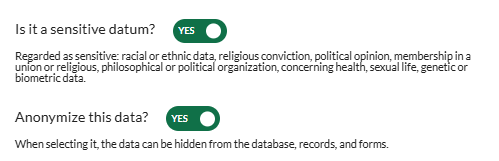
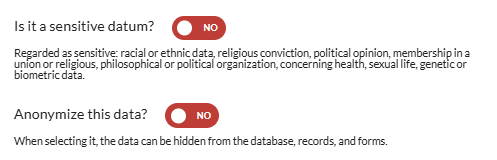
05. In Classification, select one of the available classifications. Among:
- Contract execution;
- Legal obligation;
- Consent;
- Execution of public policies;
- Study by a research agency;
- Regular exercise of a right;
- For the protection of life;
- For health care;
- Legitimate interest;
- Credit protection.
06. In Justification, provide a justification for the data being considered sensitive.
07. In the icon  , it is possible to add more than one classification and justification for the field. It is also possible to remove the classification and justification set using the Remove button
  .
.
08. After all configurations are completed, click on Save.
Publish the form
To publish a form created in the new editor, you must first publish the process to which it is linked. Only then will the saved version of the form be effectively published.
Attention!
This documentation is valid starting from the Voyager update (2.0). If you are using an earlier update, it may contain information different from what you see on your platform.
Visão Geral
Import HTML Content
Conteúdo das Ferramentas
Tarefas